Hiring independent contractors can give a business flexibility without adding every skill to payroll, but contractor payments create accounting and reporting responsibilities. Contractor 1099 requirements should be considered before the first payment, not in January when Forms 1099 are due. A missing W-9, unclear classification, or payments spread across checks, ACH, cards, and apps can create year-end confusion. A strong process connects onboarding, bookkeeping, payment-method tracking, and information reporting, so the business knows what it paid, to whom, and which form, if any should be filed.

Start With Worker Classification, Not a Tax Form
Before collecting a W-9, confirm that the worker is being treated as an independent contractor rather than an employee. A 1099 form does not make someone a contractor; the working relationship and degree of control matter. If a worker should be treated as an employee, wages generally belong on Form W-2 instead of Form 1099-NEC, and outsourced payroll services can help set that worker up correctly. Getting this right at onboarding prevents payroll and tax problems from being built into the process.
Collect Form W-9 Before the First Payment
For a U.S. contractor, Form W-9 provides the legal name, business name when applicable, federal tax classification, address, and taxpayer identification number needed for information reporting. The W-9 for contractors is an onboarding document, not a year-end afterthought. Waiting until year-end often means chasing people who have finished the project. IRS guidance recommends keeping the W-9 in your records for four years. A complete vendor file, supported by vendor invoice management, also helps the accounting team match payments to the correct payee.
Track More Than the Total Amount Paid
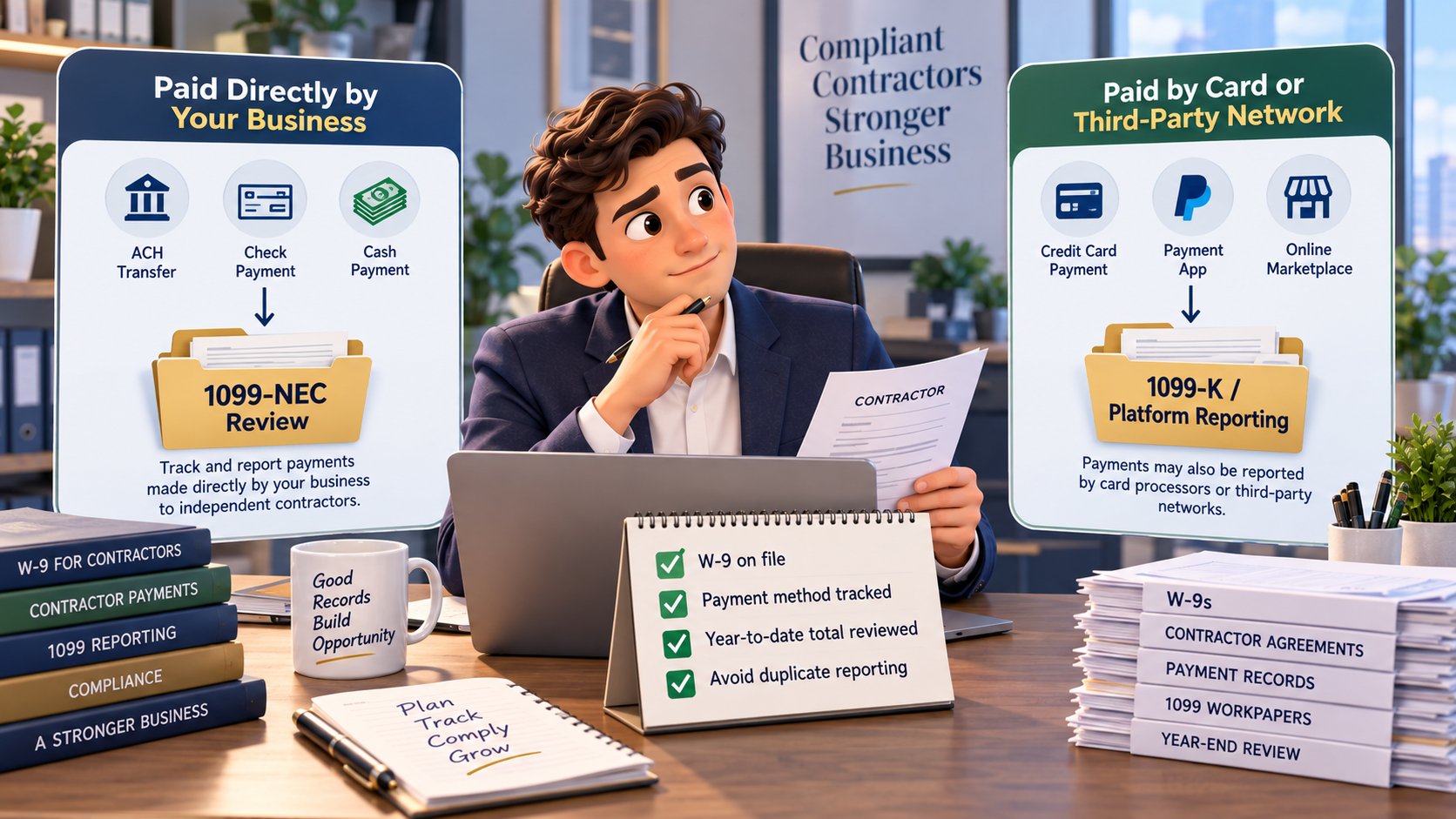
Good independent contractor bookkeeping should capture the contractor name, tax information, payment date, amount, and payment method. Payment method matters because it can determine who has the reporting responsibility. Checks, ACH transfers, and other direct payments are reviewed for Form 1099-NEC reporting. Certain card or third-party network payments may instead fall under Form 1099-K reporting by the payment settlement entity. Without that distinction, the same contractor can appear to need reporting twice.
The 2026 1099-NEC Threshold Has Changed
For payments made in 2026, the IRS reporting threshold for many nonemployee service payments is $2,000, increased from the prior $600 threshold. Businesses should not rely on an old year-end checklist. Form 1099-NEC generally applies when reportable direct payments for nonemployee services meet the applicable threshold. Special rules can still apply, including certain attorney payments and backup-withholding situations.
Understand 1099-NEC Versus 1099-K
One of the most common year-end mistakes is treating every contractor payment the same. Direct business payments may be included in the 1099-NEC review. Credit-card or certain third-party network payments are generally reported under Form 1099-K rules by the payment settlement entity and should not also be reported by the business on Form 1099-NEC. For third-party settlement organizations, the 2026 federal Form 1099-K threshold is generally more than $20,000 and more than 200 transactions, although a platform may issue a form below that level. Tracking payment channels throughout the year helps prevent duplicate reporting.
Do Not Wait Until January for the Year-End Review
Review contractor files before year-end. Confirm that W-9s are complete, names and TINs match vendor records, payment totals are reasonable, and payment methods are separated correctly. Missing forms should be requested while the relationship is still active. Form 1099-NEC is generally due by January 31, subject to the next-business-day rule when the date falls on a weekend or legal holiday. A clean review turns filing into a final step rather than an emergency cleanup project. Businesses that want support on the filing side can rely on tax compliance services to keep 1099 preparation on schedule.

Illustrative Case Study: One Contractor, Three Payment Methods
Same contractor. Different payment channels.
Consider a consulting business that pays the same designer by ACH, company credit card, and an online payment platform. If the accounting team simply totals every payment under the vendor name, it may overstate what the business itself should report on Form 1099-NEC. A better process separates direct payments from platform-processed payments, keeps the W-9 with the vendor record, and reviews each payment channel before preparing the 1099 workpaper. The contractor still reports taxable income, but the payer avoids duplicate information reporting.
How Flexible Contractor Accounting Support Can Help
Connected onboarding and bookkeeping for stress-free compliance
Contractor compliance is easier when onboarding and bookkeeping are connected. Ambit Tax & Accounting can help businesses organize W-9 collection, contractor records, payment-method tracking, account coding, and year-end 1099 workpapers as part of ongoing bookkeeping or outsourced accounting services. Management keeps approval over vendors and payments while the accounting workflow keeps records ready for review.
Conclusion
Contractor 1099 requirements work best when treated as a year-round accounting process rather than a January filing task. Start with proper worker classification, collect Form W-9 before payment, keep accurate contractor records, and separate direct payments from card or platform transactions. Those steps make 1099-NEC and 1099-K review clearer and reduce the risk of duplicate or incomplete reporting. If contractor payments are spread across several systems or your team is still chasing W-9s at year-end, Ambit Tax & Accounting can help build a cleaner contractor bookkeeping and 1099 reporting process.
Make contractor reporting a process—not a January scramble.
Build cleaner W-9 records, payment tracking, and year-end 1099 workpapers with Ambit Tax & Accounting.
Book a Free Consultation